
Land as Investment vs. Stocks: Which Builds Real Wealth?
When most people think about investing, they think about stocks. Ticker symbols, 401(k)s, index funds, the daily green-or-red of the market. But there’s an older, more tangible way to build wealth — one your grandparents probably understood better than most Wall Street analysts: land. If you’re weighing land as investment vs. stocks, this guide will walk you through how each performs, what risks they carry, and why a growing number of Americans are diversifying away from paper assets and into rural acreage.
At Classic Country Land, we’ve watched buyers from every background — teachers, welders, tech workers, retirees — quietly build real, durable wealth by purchasing affordable rural land with in-house owner financing. You don’t need to be rich to start. Down payments begin at $249, and there’s no credit check. But before we get to the “how,” let’s tackle the “why.”
The Core Difference: Paper vs. Ground
A stock is a piece of paper (well, digital paper these days) that represents a claim on a company’s future earnings. Its value depends entirely on what someone else is willing to pay for it, which in turn depends on corporate decisions, macroeconomic forces, and investor mood.
Land is different. Land is physical. You can stand on it, fence it, camp on it, hunt it, build on it, farm it, or simply watch the sun set over it. Its value comes from its utility, its location, and the finite supply of earth — no one is making more land.
That fundamental difference — paper claim versus physical asset — shapes everything about how these two investments behave.
Historical Returns: What the Numbers Say
Let’s start with a fair comparison.
Stocks
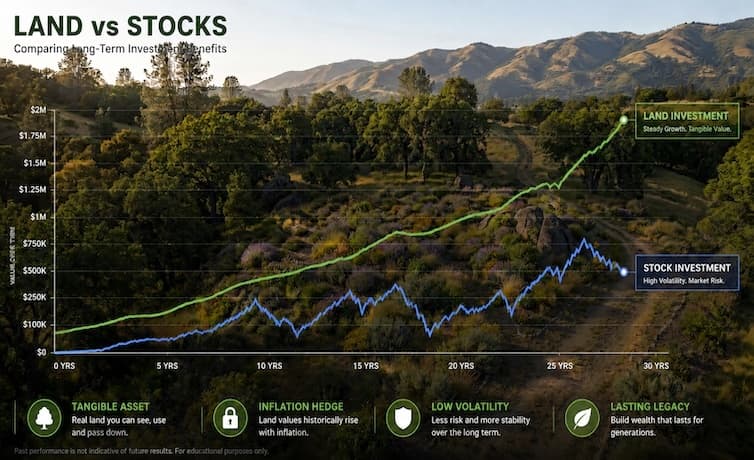
The S&P 500 has delivered an average annual return of roughly 10% over the long term (before inflation), or about 7% after inflation. That’s a strong, well-documented track record. However, that average hides brutal drawdowns — a 50% crash in 2008, a 34% crash in March 2020, and several smaller corrections along the way.
Rural Land
According to USDA data, U.S. farm real estate value has appreciated steadily for decades, with gains that often outpace inflation. Rural recreational and rural residential land in fast-growing regions has, in some cases, posted annual appreciation rivaling or exceeding stocks. And unlike stocks, land rarely experiences overnight 30% crashes — its value tends to be sticky and slow-moving.
Neither asset is a guaranteed winner. But land has some unique characteristics that stocks simply can’t replicate.
Advantages of Investing in Land
1. It’s a Tangible Asset
When you own land, you own something real. You can visit it, walk it, and use it. That’s not just emotional — it’s financial. Tangible assets tend to hold value during currency devaluation, inflation spikes, or financial market panics.
2. It Has Intrinsic Utility
Even if the “market” never bid up your land another dollar, you could still hunt on it, camp on it, raise livestock on it, park an RV on it, or retire to it. A stock that never goes up is just a losing trade. Land that never goes up is still useful.
3. Low Correlation with Stocks
Financial advisors love the word “diversification” — and with good reason. When stocks crash, bonds, commodities, and real assets often hold up better. Land, especially rural recreational land, has historically shown weak correlation with the S&P 500. That’s portfolio gold.
4. Inflation Hedge
When inflation rises, the value of paper assets can erode, but the replacement cost of physical land (and the improvements on it) typically rises with it. Land has historically been one of the classic inflation hedges.
5. No Counterparty Risk
A stock depends on a company’s board, CEO, accounting, and customer base. A bond depends on a borrower paying you back. Land is just… land. It doesn’t go bankrupt. It doesn’t get delisted.
6. You Can Use Owner Financing
Here’s the part most investors never consider: you can finance land directly through the seller, with none of the friction of traditional bank loans. At Classic Country Land, we offer in-house owner financing with no credit check, no background check, and down payments starting at $249. Try getting into a blue-chip stock position with that kind of leverage and flexibility.
Advantages of Investing in Stocks
Let’s be fair — stocks have real advantages too.
Liquidity. You can sell a stock in seconds. Selling land can take weeks or months.
Low minimums. You can buy one share of an ETF for $50. Rural land is cheap by real estate standards, but still typically requires a few thousand to a few tens of thousands of dollars.
Passive management. A total-market index fund requires essentially zero maintenance. Land may need occasional upkeep — fencing, property taxes, brush clearing.
Compounding dividends. Many stocks pay dividends that can be reinvested automatically.
These are real benefits. Most prudent investors will hold both stocks and land, not one or the other.
Disadvantages to Understand
No honest comparison skips the downsides.
Land Drawbacks
- Illiquidity. You can’t sell land with a click.
- Holding costs. Property taxes, though usually modest on rural land, still apply.
- Active effort for some uses. Timber, farming, and rental income require work.
- Regional risk. A parcel in a declining area may not appreciate.
Stock Drawbacks
- Volatility. 20% to 50% drawdowns happen repeatedly throughout a lifetime.
- Abstractness. You can’t use a stock certificate for anything.
- Fraud and corporate risk. Enron, Lehman Brothers, and many others have taught us that “safe” stocks can go to zero.
- Dependency on systems. Your stock account depends on brokerages, exchanges, and settlement systems functioning normally.
Who Should Consider Land Over Stocks?
Land isn’t for everyone, and it doesn’t have to replace your stock portfolio. But it’s especially appealing if you:
- Value tangible ownership and want something real to pass on to your kids.
- Are worried about inflation or currency debasement.
- Want an asset you can actually use — for hunting, camping, homesteading, or off-grid living.
- Prefer a slower, steadier appreciation curve over volatile market swings.
- Can’t get traditional financing easily and want a path to ownership without banks.
Why Rural Land Is Especially Compelling Right Now
Several trends make rural land an unusually strong investment thesis in 2026:
Remote work is permanent. Millions of Americans can now live anywhere with a decent internet connection. That has driven sustained demand for rural property in states like Texas, Tennessee, Colorado, and Wyoming.
Housing affordability is strained. Many Americans are looking for lower-cost alternatives — including rural land where they can build a modest home, a tiny house, or a cabin. (See our guide on land for tiny homes for more.)
The homesteading movement is growing. Self-reliance, food independence, and off-grid living are no longer fringe interests — they’re mainstream goals for a rising generation of buyers.
Supply is finite. Every year, more rural acreage is developed, fragmented, or tied up. The window for affordable rural parcels will narrow over time.
A Real-World Scenario
Let’s compare two hypothetical $10,000 investments in 2026.
Option A: $10,000 in a broad stock index fund. Assume 7% real returns compounded over 20 years. That could grow to roughly $38,700 before taxes.
Option B: $10,000 into a rural parcel via owner financing. You put $999 down to secure the property. You pay on the note for several years until paid off. Over 20 years, assuming a modest 5% annual appreciation, the land alone might be worth around $26,500 — and in the meantime, you’ve had the use of the land for hunting, camping, a future cabin, or simply peace of mind. And you’ve done it with a fraction of the initial cash outlay.
Neither option is “better” in isolation. But they behave differently, and owning both smooths the ride.
Note: These are illustrative scenarios, not guarantees. Past performance does not guarantee future returns.
How to Start Investing in Land
If land investing sounds right for you, here’s how to begin.
1. Define your goal. Are you buying for long-term appreciation, eventual homesteading, hunting, or simple legacy?
2. Pick your state. Classic Country Land offers properties in Arizona, Arkansas, California, Colorado, Kansas, Kentucky, Mississippi, Missouri, New Mexico, Oklahoma, Tennessee, Texas, and Wyoming.
3. Set a budget. Our affordable listings make entry easy, with many parcels requiring as little as $999 down.
4. Use owner financing to preserve capital. With no credit check and no bank needed, you keep your cash flow and credit lines free for other investments — including stocks.
5. Hold long-term. Like stocks, land rewards patience. Think in years, not months.
Ready to Diversify Beyond the Stock Market?
A well-balanced portfolio doesn’t just hold stocks and bonds — it holds real assets, too. Land is one of the oldest, most reliable stores of wealth in human history, and today you can add it to your portfolio with just $999 down and a simple owner-financed contract.
Browse available properties today, learn how it works, or call us at 972-649-6200 to speak with a real person about your investment goals.
Frequently Asked Questions
Is land really a better investment than stocks?
It depends on your goals and timeframe. Land offers tangible ownership, inflation protection, and lower volatility, while stocks offer liquidity and historically strong returns. Many investors hold both for diversification.
How much money do I need to start investing in land?
With Classic Country Land’s owner financing, you can start with as little as $999 down. That’s dramatically lower than most traditional real estate investments.
Can I lose money investing in land?
Yes. Like any investment, land carries risk. Values can stagnate or fall in certain regions or time periods. The best protection is buying desirable, well-located parcels and holding long-term.
Is rural land a good hedge against inflation?
Historically, yes. Real assets like land tend to rise in value during inflationary periods because their replacement cost increases with inflation.
Does owner financing hurt or help my return on investment?
Owner financing can actually help your return by letting you control a larger asset with a smaller cash outlay. The downside is interest costs — but if the land appreciates faster than your interest rate, you come out ahead.
Ready to add rural land to your investment portfolio? Visit classiccountryland.com or call 972-649-6200 to get started.
When most people think about investing, they think about stocks. Ticker symbols, 401(k)s, index funds, the daily green-or-red of the market. But there’s an older, more tangible way to build wealth — one your grandparents probably understood better than most Wall Street analysts: land. If you’re weighing land as investment vs. stocks, this guide will walk you through how each performs, what risks they carry, and why a growing number of Americans are diversifying away from paper assets and into rural acreage.
At Legacy Land, we’ve watched buyers from every background — teachers, welders, tech workers, retirees — quietly build real, durable wealth by purchasing affordable rural land with in-house owner financing. You don’t need to be rich to start. Down payments begin at $249, and there’s no credit check. But before we get to the “how,” let’s tackle the “why.”
The Core Difference: Paper vs. Ground
A stock is a piece of paper (well, digital paper these days) that represents a claim on a company’s future earnings. Its value depends entirely on what someone else is willing to pay for it, which in turn depends on corporate decisions, macroeconomic forces, and investor mood.
Land is different. Land is physical. You can stand on it, fence it, camp on it, hunt it, build on it, farm it, or simply watch the sun set over it. Its value comes from its utility, its location, and the finite supply of earth — no one is making more land.
That fundamental difference — paper claim versus physical asset — shapes everything about how these two investments behave.
Historical Returns: What the Numbers Say
Let’s start with a fair comparison.
Stocks
The S&P 500 has delivered an average annual return of roughly 10% over the long term (before inflation), or about 7% after inflation. That’s a strong, well-documented track record. However, that average hides brutal drawdowns — a 50% crash in 2008, a 34% crash in March 2020, and several smaller corrections along the way.
Rural Land
According to USDA data, U.S. farm real estate value has appreciated steadily for decades, with gains that often outpace inflation. Rural recreational and rural residential land in fast-growing regions has, in some cases, posted annual appreciation rivaling or exceeding stocks. And unlike stocks, land rarely experiences overnight 30% crashes — its value tends to be sticky and slow-moving.
Neither asset is a guaranteed winner. But land has some unique characteristics that stocks simply can’t replicate.
Advantages of Investing in Land
1. It’s a Tangible Asset
When you own land, you own something real. You can visit it, walk it, and use it. That’s not just emotional — it’s financial. Tangible assets tend to hold value during currency devaluation, inflation spikes, or financial market panics.
2. It Has Intrinsic Utility
Even if the “market” never bid up your land another dollar, you could still hunt on it, camp on it, raise livestock on it, park an RV on it, or retire to it. A stock that never goes up is just a losing trade. Land that never goes up is still useful.
3. Low Correlation with Stocks
Financial advisors love the word “diversification” — and with good reason. When stocks crash, bonds, commodities, and real assets often hold up better. Land, especially rural recreational land, has historically shown weak correlation with the S&P 500. That’s portfolio gold.
4. Inflation Hedge
When inflation rises, the value of paper assets can erode, but the replacement cost of physical land (and the improvements on it) typically rises with it. Land has historically been one of the classic inflation hedges.
5. No Counterparty Risk
A stock depends on a company’s board, CEO, accounting, and customer base. A bond depends on a borrower paying you back. Land is just… land. It doesn’t go bankrupt. It doesn’t get delisted.
6. You Can Use Owner Financing
Here’s the part most investors never consider: you can finance land directly through the seller, with none of the friction of traditional bank loans. At Legacy Land, we offer in-house owner financing with no credit check, no background check, and down payments starting at $249. Try getting into a blue-chip stock position with that kind of leverage and flexibility.
Advantages of Investing in Stocks
Let’s be fair — stocks have real advantages too.
Liquidity. You can sell a stock in seconds. Selling land can take weeks or months.
Low minimums. You can buy one share of an ETF for $50. Rural land is cheap by real estate standards, but still typically requires a few thousand to a few tens of thousands of dollars.
Passive management. A total-market index fund requires essentially zero maintenance. Land may need occasional upkeep — fencing, property taxes, brush clearing.
Compounding dividends. Many stocks pay dividends that can be reinvested automatically.
These are real benefits. Most prudent investors will hold both stocks and land, not one or the other.
Disadvantages to Understand
No honest comparison skips the downsides.
Land Drawbacks
- Illiquidity. You can’t sell land with a click.
- Holding costs. Property taxes, though usually modest on rural land, still apply.
- Active effort for some uses. Timber, farming, and rental income require work.
- Regional risk. A parcel in a declining area may not appreciate.
Stock Drawbacks
- Volatility. 20% to 50% drawdowns happen repeatedly throughout a lifetime.
- Abstractness. You can’t use a stock certificate for anything.
- Fraud and corporate risk. Enron, Lehman Brothers, and many others have taught us that “safe” stocks can go to zero.
- Dependency on systems. Your stock account depends on brokerages, exchanges, and settlement systems functioning normally.
Who Should Consider Land Over Stocks?
Land isn’t for everyone, and it doesn’t have to replace your stock portfolio. But it’s especially appealing if you:
- Value tangible ownership and want something real to pass on to your kids.
- Are worried about inflation or currency debasement.
- Want an asset you can actually use — for hunting, camping, homesteading, or off-grid living.
- Prefer a slower, steadier appreciation curve over volatile market swings.
- Can’t get traditional financing easily and want a path to ownership without banks.
Why Rural Land Is Especially Compelling Right Now
Several trends make rural land an unusually strong investment thesis in 2026:
Remote work is permanent. Millions of Americans can now live anywhere with a decent internet connection. That has driven sustained demand for rural property in states like Texas, Tennessee, Colorado, and Wyoming.
Housing affordability is strained. Many Americans are looking for lower-cost alternatives — including rural land where they can build a modest home, a tiny house, or a cabin. (See our guide on land for tiny homes for more.)
The homesteading movement is growing. Self-reliance, food independence, and off-grid living are no longer fringe interests — they’re mainstream goals for a rising generation of buyers.
Supply is finite. Every year, more rural acreage is developed, fragmented, or tied up. The window for affordable rural parcels will narrow over time.
A Real-World Scenario
Let’s compare two hypothetical $10,000 investments in 2026.
Option A: $10,000 in a broad stock index fund. Assume 7% real returns compounded over 20 years. That could grow to roughly $38,700 before taxes.
Option B: $10,000 into a rural parcel via owner financing. You put $999 down to secure the property. You pay on the note for several years until paid off. Over 20 years, assuming a modest 5% annual appreciation, the land alone might be worth around $26,500 — and in the meantime, you’ve had the use of the land for hunting, camping, a future cabin, or simply peace of mind. And you’ve done it with a fraction of the initial cash outlay.
Neither option is “better” in isolation. But they behave differently, and owning both smooths the ride.
Note: These are illustrative scenarios, not guarantees. Past performance does not guarantee future returns.
How to Start Investing in Land
If land investing sounds right for you, here’s how to begin.
1. Define your goal. Are you buying for long-term appreciation, eventual homesteading, hunting, or simple legacy?
2. Pick your state. Legacy Land offers properties in Arizona, Arkansas, California, Colorado, Kansas, Kentucky, Mississippi, Missouri, New Mexico, Oklahoma, Tennessee, Texas, and Wyoming.
3. Set a budget. Our affordable listings make entry easy, with many parcels requiring as little as $999 down.
4. Use owner financing to preserve capital. With no credit check and no bank needed, you keep your cash flow and credit lines free for other investments — including stocks.
5. Hold long-term. Like stocks, land rewards patience. Think in years, not months.
Ready to Diversify Beyond the Stock Market?
A well-balanced portfolio doesn’t just hold stocks and bonds — it holds real assets, too. Land is one of the oldest, most reliable stores of wealth in human history, and today you can add it to your portfolio with just $999 down and a simple owner-financed contract.
Browse available properties today, learn how it works, or call us at 972-649-6200 to speak with a real person about your investment goals.
Frequently Asked Questions
Is land really a better investment than stocks?
It depends on your goals and timeframe. Land offers tangible ownership, inflation protection, and lower volatility, while stocks offer liquidity and historically strong returns. Many investors hold both for diversification.
How much money do I need to start investing in land?
With Legacy Land’s owner financing, you can start with as little as $999 down. That’s dramatically lower than most traditional real estate investments.
Can I lose money investing in land?
Yes. Like any investment, land carries risk. Values can stagnate or fall in certain regions or time periods. The best protection is buying desirable, well-located parcels and holding long-term.
Is rural land a good hedge against inflation?
Historically, yes. Real assets like land tend to rise in value during inflationary periods because their replacement cost increases with inflation.
Does owner financing hurt or help my return on investment?
Owner financing can actually help your return by letting you control a larger asset with a smaller cash outlay. The downside is interest costs — but if the land appreciates faster than your interest rate, you come out ahead.
Ready to add rural land to your investment portfolio? Visit classiccountryland.com or call 972-649-6200 to get started.