
Septic Systems and Perc Tests: What Every Rural Land Buyer Needs to Know
If you’re planning to build a cabin, home, or even park an RV long-term on rural land, one question matters more than almost any other: where will the wastewater go? Outside city limits there’s no sewer line to tap into. Your land has to handle it — and whether it can depends on what’s happening a few feet underground.
That’s where perc tests and septic systems come in. Understanding both before you buy can save you from expensive surprises after. The good news: none of this is complicated once someone explains it plainly.
Here’s the plain-English version.
What a Septic System Actually Does
A conventional septic system has two parts. The septic tank collects wastewater and lets solids settle, where bacteria slowly break them down. The liquid then flows out to a drain field — a network of buried, perforated pipes — where soil filters and treats it naturally.
The whole system is passive and buried. When the soil cooperates, it can run for decades with nothing more than occasional pumping. When the soil doesn’t cooperate, things get more expensive — which is why the perc test exists.
What a Perc Test Is (and Why It Matters)
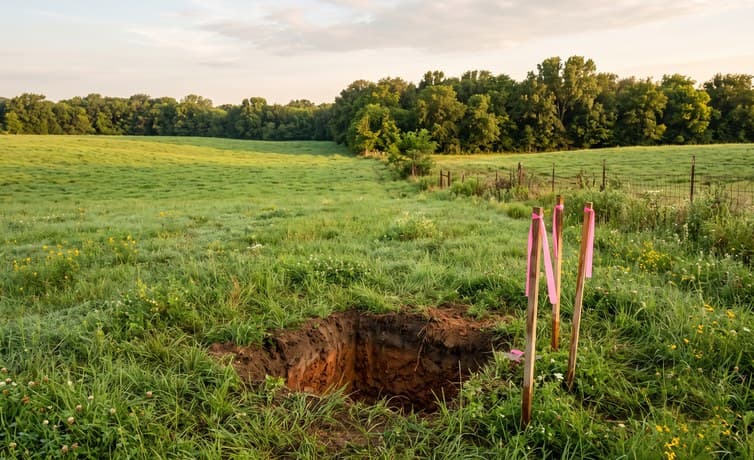
A percolation test measures how quickly water drains through your soil. A tester digs one or more holes at the planned drain field site, soaks them, then times how fast the water level drops.
Why You Should Care Before Buying
The result determines what kind of system the land can support:
- Fast, sandy soils usually pass easily — a standard system works.
- Slow, heavy clay may require an engineered mound or aerobic system costing two to three times more.
- Ground that fails entirely may not be buildable at all without major workarounds.
A perc test typically costs a few hundred dollars to around $1,300 depending on your county and how many holes are required — cheap insurance compared to buying a homesite that can’t support a home.
What Septic Systems Cost in 2026
Costs vary by soil, region, and system type, but current ranges look like this:
- Conventional gravity system: roughly $7,000–$15,000 installed for a typical three-bedroom home in decent soil.
- Mound or aerobic systems (for clay soils or high water tables): often $12,000–$25,000 or more.
- Perc test: commonly $750–$1,900, sometimes as low as $300 for a simple hand-dug test.
Verify local numbers with your county health department — they issue the permits and can tell you exactly what’s required.
How the Permit Process Usually Works
Every state handles septic permitting a little differently, but the rural pattern is similar most places. Before installation, the county health department (or state equivalent) reviews a soil evaluation or perc test, approves a system design sized to your bedroom count, and issues a permit. A licensed installer puts the system in, an inspector signs off, and you’re done.
Two practical tips: talk to the health department early, because they know the local soils better than anyone and will often tell you over the phone what systems typically work in your area. And hire local installers — the crew that has put fifty systems in your county’s clay knows tricks an out-of-town contractor doesn’t.
How to Protect Yourself When Buying Land
You don’t need a completed perc test to buy land, especially if you’re years away from building. But you should go in with clear eyes:
- Ask the seller whether any perc or soil evaluation has been done.
- Call the county health department and ask about septic requirements and minimum lot sizes.
- Look at the neighbors — existing homes nearby usually mean workable soil.
- Favor higher, well-drained ground over low, wet spots when picking a build site.
- Budget for the test as one of your first steps after purchase if you plan to build.
If You’re Staying Off-Grid
Not everyone needs a full septic system on day one. Many counties allow composting toilets or holding tanks for camps and part-time use — rules vary, so check locally before you haul in the camper.
Start with Land That Fits Your Plans — Classic Country Land Can Help
The easiest way to avoid septic headaches is to buy land suited to what you want to do with it — and to buy from people who describe their properties honestly. Classic Country Land has been helping buyers do exactly that for more than 25 years, with in-house owner financing on every property: no credit or background checks, down payments starting at just $999, plus a one-time $249 document fee at closing.
With properties in 14 states — from wooded hunting tracts to open homesites — there’s a parcel to match nearly any plan. Browse current listings at classiccountryland.com or call 972-649-6200 with questions. We’ll help you find ground your plans can actually stand on.
If you’re planning to build a cabin, home, or even park an RV long-term on rural land, one question matters more than almost any other: where will the wastewater go? Outside city limits there’s no sewer line to tap into. Your land has to handle it — and whether it can depends on what’s happening a few feet underground.
That’s where perc tests and septic systems come in. Understanding both before you buy can save you from expensive surprises after. The good news: none of this is complicated once someone explains it plainly.
Here’s the plain-English version.
What a Septic System Actually Does
A conventional septic system has two parts. The septic tank collects wastewater and lets solids settle, where bacteria slowly break them down. The liquid then flows out to a drain field — a network of buried, perforated pipes — where soil filters and treats it naturally.
The whole system is passive and buried. When the soil cooperates, it can run for decades with nothing more than occasional pumping. When the soil doesn’t cooperate, things get more expensive — which is why the perc test exists.
What a Perc Test Is (and Why It Matters)
A percolation test measures how quickly water drains through your soil. A tester digs one or more holes at the planned drain field site, soaks them, then times how fast the water level drops.
Why You Should Care Before Buying
The result determines what kind of system the land can support:
- Fast, sandy soils usually pass easily — a standard system works.
- Slow, heavy clay may require an engineered mound or aerobic system costing two to three times more.
- Ground that fails entirely may not be buildable at all without major workarounds.
A perc test typically costs a few hundred dollars to around $1,300 depending on your county and how many holes are required — cheap insurance compared to buying a homesite that can’t support a home.
What Septic Systems Cost in 2026
Costs vary by soil, region, and system type, but current ranges look like this:
- Conventional gravity system: roughly $7,000–$15,000 installed for a typical three-bedroom home in decent soil.
- Mound or aerobic systems (for clay soils or high water tables): often $12,000–$25,000 or more.
- Perc test: commonly $750–$1,900, sometimes as low as $300 for a simple hand-dug test.
Verify local numbers with your county health department — they issue the permits and can tell you exactly what’s required.
How the Permit Process Usually Works
Every state handles septic permitting a little differently, but the rural pattern is similar most places. Before installation, the county health department (or state equivalent) reviews a soil evaluation or perc test, approves a system design sized to your bedroom count, and issues a permit. A licensed installer puts the system in, an inspector signs off, and you’re done.
Two practical tips: talk to the health department early, because they know the local soils better than anyone and will often tell you over the phone what systems typically work in your area. And hire local installers — the crew that has put fifty systems in your county’s clay knows tricks an out-of-town contractor doesn’t.
How to Protect Yourself When Buying Land
You don’t need a completed perc test to buy land, especially if you’re years away from building. But you should go in with clear eyes:
- Ask the seller whether any perc or soil evaluation has been done.
- Call the county health department and ask about septic requirements and minimum lot sizes.
- Look at the neighbors — existing homes nearby usually mean workable soil.
- Favor higher, well-drained ground over low, wet spots when picking a build site.
- Budget for the test as one of your first steps after purchase if you plan to build.
If You’re Staying Off-Grid
Not everyone needs a full septic system on day one. Many counties allow composting toilets or holding tanks for camps and part-time use — rules vary, so check locally before you haul in the camper.
Start with Land That Fits Your Plans — Legacy Land Can Help
The easiest way to avoid septic headaches is to buy land suited to what you want to do with it — and to buy from people who describe their properties honestly. Legacy Land has been helping buyers do exactly that for more than 25 years, with in-house owner financing on every property: no credit or background checks, down payments starting at just $999, plus a one-time $249 document fee at closing.
With properties in 14 states — from wooded hunting tracts to open homesites — there’s a parcel to match nearly any plan. Browse current listings at classiccountryland.com or call 972-649-6200 with questions. We’ll help you find ground your plans can actually stand on.