
Building a Pond on Your Rural Land: Costs, Permits, and Planning
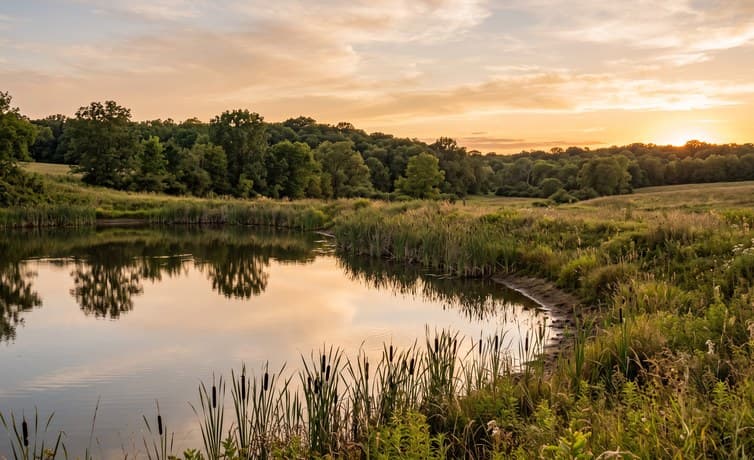
Ask landowners what they'd add to their property if they could add anything, and a pond usually tops the list. A good pond waters livestock and wildlife, holds fish, guards against drought and fire, and turns an ordinary parcel into the place where everyone wants to spend the afternoon.
A pond is also one of the few improvements that can genuinely add value to rural land rather than just consuming money.
But ponds are earthwork projects, and earthwork punishes poor planning. Here's what to know about siting, permits, and real-world costs before the excavator shows up.
What Does a Pond Actually Cost?
Pond pricing varies more than almost any other land improvement because it depends on your dirt, your site, and your goals.
The realistic range
Industry cost guides put excavated farm ponds anywhere from roughly $5,000 to $25,000 per acre of water, and a large, professionally built one-acre fishing pond can run considerably more once you add a proper dam, spillway, and finish work. Small stock ponds dug in ideal soil come in at the low end; big ponds in rocky ground at the high end.
What drives the price
- Soil type. Clay soil holds water and keeps costs down. Sandy or rocky ground may need a clay liner or synthetic liner — a major added expense.
- Excavation volume. Contractors often bill by the cubic yard, commonly a few dollars per yard for large jobs. Deeper ponds move exponentially more dirt.
- Site clearing. A pond site in open pasture is cheap to prepare; clearing heavy woods can add thousands per acre before digging starts.
- Dam and spillway work. Embankment ponds on a drainage need engineered dams — more cost, but they capture runoff naturally.
Get two or three local quotes. Rural excavation contractors who build ponds regularly will know your county's soils better than any online calculator.
Do You Need a Permit?
Sometimes. Small ponds dug entirely on upland ground, fed by rain and runoff, often need little or no permitting. But rules kick in fast when water is involved:
- Streams and wetlands. Damming a flowing stream or digging in a regulated wetland typically requires state and possibly federal (Army Corps) approval. This is the big one — never assume.
- Dam safety rules. Many states regulate dams above a certain height or storage volume.
- Water rights. In many western states, capturing water requires a permit even on your own land.
A call to your county conservation district or NRCS office before you dig is free and can save you from an expensive order to drain your new pond. NRCS offices will often help with pond siting and design at no charge — one of the best free services in rural America.
Picking the Right Spot
Good pond builders say the site chooses the pond, not the other way around.
Look for natural advantages
A gentle draw that collects runoff, clay-heavy subsoil, and enough watershed to keep the pond full — roughly 10 to 20 acres of watershed per acre of pond in much of the country — make everything cheaper.
Think about use
Put a stock pond where cattle already graze; put a fishing and swimming pond where you can see it from the porch. Keep any pond a sensible distance from your septic system and property lines.
Test your soil first
Dig test holes where you plan the pond. If the soil ribbons like modeling clay when wet, you're in business. If water drains from the hole overnight, budget for a liner.
A Pond Makes Good Land Better
A well-built pond attracts deer, ducks, and turkey, supports bass and bluegill within a couple of seasons, and gives kids a reason to put their phones down. It's the rare land project you enjoy every single day after it's done.
Plan for a little upkeep: a new pond usually takes a season or two to settle and fill, and you'll want to establish grass on the banks quickly to prevent erosion. Stock fish in the right order — forage fish like bluegill first, bass the following season — and your pond will largely take care of itself. Most state wildlife agencies publish free stocking guides, and many hatcheries deliver fingerlings right to your bank.
Start with Land Worth Improving — Classic Country Land
The first step to owning a pond is owning the land under it. Classic Country Land has spent more than 25 years helping everyday buyers get their piece of country, with properties across 20+ states — many with creeks, draws, and pond-friendly ground already in place. In-house owner financing means no credit check, no background check, and as little as $999 down.
Browse properties at classiccountryland.com or call 972-649-6200. Buy the land now — dig the pond next spring.
What you pay upfront: $999 down, plus a one-time $249 document fee at closing.
Financing disclosure: Basic-plan payments shown assume $999 down at 10.99% APR, amortized over terms up to 20 years — some contracts include a balloon payment, typically due after three years, when the remaining balance is refinanced or paid. Rates, discounts, and terms are subject to adjustment without notice.
Ask landowners what they'd add to their property if they could add anything, and a pond usually tops the list. A good pond waters livestock and wildlife, holds fish, guards against drought and fire, and turns an ordinary parcel into the place where everyone wants to spend the afternoon.
A pond is also one of the few improvements that can genuinely add value to rural land rather than just consuming money.
But ponds are earthwork projects, and earthwork punishes poor planning. Here's what to know about siting, permits, and real-world costs before the excavator shows up.
What Does a Pond Actually Cost?
Pond pricing varies more than almost any other land improvement because it depends on your dirt, your site, and your goals.
The realistic range
Industry cost guides put excavated farm ponds anywhere from roughly $5,000 to $25,000 per acre of water, and a large, professionally built one-acre fishing pond can run considerably more once you add a proper dam, spillway, and finish work. Small stock ponds dug in ideal soil come in at the low end; big ponds in rocky ground at the high end.
What drives the price
- Soil type. Clay soil holds water and keeps costs down. Sandy or rocky ground may need a clay liner or synthetic liner — a major added expense.
- Excavation volume. Contractors often bill by the cubic yard, commonly a few dollars per yard for large jobs. Deeper ponds move exponentially more dirt.
- Site clearing. A pond site in open pasture is cheap to prepare; clearing heavy woods can add thousands per acre before digging starts.
- Dam and spillway work. Embankment ponds on a drainage need engineered dams — more cost, but they capture runoff naturally.
Get two or three local quotes. Rural excavation contractors who build ponds regularly will know your county's soils better than any online calculator.
Do You Need a Permit?
Sometimes. Small ponds dug entirely on upland ground, fed by rain and runoff, often need little or no permitting. But rules kick in fast when water is involved:
- Streams and wetlands. Damming a flowing stream or digging in a regulated wetland typically requires state and possibly federal (Army Corps) approval. This is the big one — never assume.
- Dam safety rules. Many states regulate dams above a certain height or storage volume.
- Water rights. In many western states, capturing water requires a permit even on your own land.
A call to your county conservation district or NRCS office before you dig is free and can save you from an expensive order to drain your new pond. NRCS offices will often help with pond siting and design at no charge — one of the best free services in rural America.
Picking the Right Spot
Good pond builders say the site chooses the pond, not the other way around.
Look for natural advantages
A gentle draw that collects runoff, clay-heavy subsoil, and enough watershed to keep the pond full — roughly 10 to 20 acres of watershed per acre of pond in much of the country — make everything cheaper.
Think about use
Put a stock pond where cattle already graze; put a fishing and swimming pond where you can see it from the porch. Keep any pond a sensible distance from your septic system and property lines.
Test your soil first
Dig test holes where you plan the pond. If the soil ribbons like modeling clay when wet, you're in business. If water drains from the hole overnight, budget for a liner.
A Pond Makes Good Land Better
A well-built pond attracts deer, ducks, and turkey, supports bass and bluegill within a couple of seasons, and gives kids a reason to put their phones down. It's the rare land project you enjoy every single day after it's done.
Plan for a little upkeep: a new pond usually takes a season or two to settle and fill, and you'll want to establish grass on the banks quickly to prevent erosion. Stock fish in the right order — forage fish like bluegill first, bass the following season — and your pond will largely take care of itself. Most state wildlife agencies publish free stocking guides, and many hatcheries deliver fingerlings right to your bank.
Start with Land Worth Improving — Legacy Land
The first step to owning a pond is owning the land under it. Legacy Land has spent more than 25 years helping everyday buyers get their piece of country, with properties across 20+ states — many with creeks, draws, and pond-friendly ground already in place. In-house owner financing means no credit check, no background check, and as little as $999 down.
Browse properties at classiccountryland.com or call 972-649-6200. Buy the land now — dig the pond next spring.
What you pay upfront: $999 down, plus a one-time $249 document fee at closing.
Financing disclosure: Basic-plan payments shown assume $999 down at 10.99% APR, amortized over terms up to 20 years — some contracts include a balloon payment, typically due after three years, when the remaining balance is refinanced or paid. Rates, discounts, and terms are subject to adjustment without notice.