
Buying Land for a Barndominium: What to Know Before You Build
The barndominium has gone from farm-country curiosity to one of the most popular ways to build a rural home. Metal shell, open floor plan, workshop under the same roof as the living room — it's practical, fast to build, and often cheaper per square foot than a conventional house.
But every barndo starts the same way: with a piece of land. And the parcel you choose has more influence on your final cost and timeline than the building itself.
Here's what to look for when you're buying land specifically with a barndominium in mind.
What a Barndominium Costs to Build
Knowing the building budget helps you set the land budget. In 2026, most barndominium builds run $65 to $160 per square foot — roughly $130,000 to $320,000 for a 2,000-square-foot home, depending on finish level.
The Kit Route
Prefab kits cost about $20 to $35 per square foot for the shell — walls, trusses, metal siding, and roofing — with assembly labor adding $10 to $15 per square foot. That's the budget-friendly path many owner-builders take.
The Full-Build Route
A finished barndo with upgraded interior selections typically lands in the $125 to $185 per square foot range. Still favorable against conventional stick-built homes in most rural markets.
The takeaway: a barndominium rewards buyers who save money on land and put the difference into the build.
What to Look for in the Parcel
A barndo has a few site needs that ordinary cabins don't. Check these before you commit.
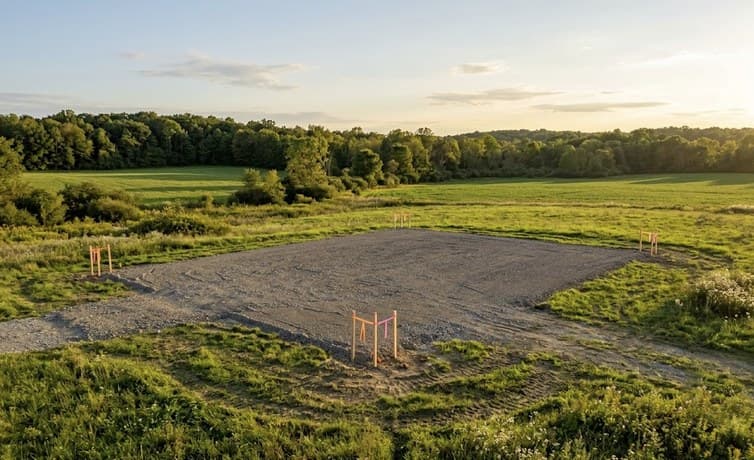
- Level or gently sloped ground — barndominiums sit on concrete slab foundations, and a flat building site keeps dirt work affordable.
- Truck access — kit deliveries arrive on full-size flatbeds, and concrete trucks need to reach the pad. A tight, washed-out track adds real cost.
- Room for the slab and apron — a 40x60 shell plus parking and turnaround space wants a generous cleared area.
- Well and septic potential — like any rural home, you'll need water and a perc-friendly spot for the septic field.
- Distance to power — metal buildings wire easily, but the line extension from the road is priced by the foot.
Zoning, Covenants, and Permits
This is where barndo buyers need to slow down and read.
County Rules Vary
Most rural counties welcome barndominiums, but some have minimum square footage requirements or residential design standards. A call to the county building office answers this in minutes.
Read the Covenants
Even lightly restricted rural land carries recorded covenants, and some subdivisions restrict metal buildings or set minimum home sizes. Rural acreage with minimal covenants — the kind written to stop junk piles, not to dictate architecture — is generally barndo-friendly, but read the actual document before you buy. A seller worth dealing with will hand it over without being asked.
Financing Is the Other Homework
Some banks still hesitate on barndominium construction loans. Owning your land outright first — or buying it with owner financing while you save for the build — sidesteps much of that friction and gives you a stronger position when you do talk to a builder or lender.
Why Raw Land Plus a Barndo Is a Smart Pairing
The barndominium's biggest advantage is speed and simplicity, and raw rural land is where that advantage pays best.
- Buy now, build later — hold the land at a low monthly payment while you plan and price the build.
- Live the transition — many owners camp or park an RV on their land during construction.
- Workshop income — the shop bay can house a business, equipment, or storage from day one.
- Acreage over amenities — a barndo on 10 quiet acres often costs less than a small house on a town lot.
There's a sequencing advantage, too. Because a barndominium shell goes up in weeks rather than months, the slow parts of the project are the ones tied to the land — the driveway, the well, the septic approval, the power line. Buyers who purchase their parcel a year or two ahead can knock those items out gradually, paying cash as they go, so that when the kit arrives the site is ready and the build moves at full speed.
Find Your Barndominium Land with Classic Country Land
The right barndo starts with the right parcel, and that's the part Classic Country Land makes easy. For more than 25 years we've helped people become landowners with in-house owner financing on every property — no credit or background checks, ever.
Down payments start at just $999, plus a one-time $249 document fee at closing, with fixed monthly payments that leave your build budget intact. With properties across 20+ states, you can compare level, accessible parcels with the acreage and elbow room a barndominium deserves.
Browse current listings at classiccountryland.com or call 972-649-6200. Your barndominium needs a home address — let's find it.
What you pay upfront: $999 down, plus a one-time $249 document fee at closing.
Financing disclosure: Basic-plan payments shown assume $999 down at 10.99% APR, amortized over terms up to 20 years — some contracts include a balloon payment, typically due after three years, when the remaining balance is refinanced or paid. Rates, discounts, and terms are subject to adjustment without notice.
The barndominium has gone from farm-country curiosity to one of the most popular ways to build a rural home. Metal shell, open floor plan, workshop under the same roof as the living room — it's practical, fast to build, and often cheaper per square foot than a conventional house.
But every barndo starts the same way: with a piece of land. And the parcel you choose has more influence on your final cost and timeline than the building itself.
Here's what to look for when you're buying land specifically with a barndominium in mind.
What a Barndominium Costs to Build
Knowing the building budget helps you set the land budget. In 2026, most barndominium builds run $65 to $160 per square foot — roughly $130,000 to $320,000 for a 2,000-square-foot home, depending on finish level.
The Kit Route
Prefab kits cost about $20 to $35 per square foot for the shell — walls, trusses, metal siding, and roofing — with assembly labor adding $10 to $15 per square foot. That's the budget-friendly path many owner-builders take.
The Full-Build Route
A finished barndo with upgraded interior selections typically lands in the $125 to $185 per square foot range. Still favorable against conventional stick-built homes in most rural markets.
The takeaway: a barndominium rewards buyers who save money on land and put the difference into the build.
What to Look for in the Parcel
A barndo has a few site needs that ordinary cabins don't. Check these before you commit.
- Level or gently sloped ground — barndominiums sit on concrete slab foundations, and a flat building site keeps dirt work affordable.
- Truck access — kit deliveries arrive on full-size flatbeds, and concrete trucks need to reach the pad. A tight, washed-out track adds real cost.
- Room for the slab and apron — a 40x60 shell plus parking and turnaround space wants a generous cleared area.
- Well and septic potential — like any rural home, you'll need water and a perc-friendly spot for the septic field.
- Distance to power — metal buildings wire easily, but the line extension from the road is priced by the foot.
Zoning, Covenants, and Permits
This is where barndo buyers need to slow down and read.
County Rules Vary
Most rural counties welcome barndominiums, but some have minimum square footage requirements or residential design standards. A call to the county building office answers this in minutes.
Read the Covenants
Even lightly restricted rural land carries recorded covenants, and some subdivisions restrict metal buildings or set minimum home sizes. Rural acreage with minimal covenants — the kind written to stop junk piles, not to dictate architecture — is generally barndo-friendly, but read the actual document before you buy. A seller worth dealing with will hand it over without being asked.
Financing Is the Other Homework
Some banks still hesitate on barndominium construction loans. Owning your land outright first — or buying it with owner financing while you save for the build — sidesteps much of that friction and gives you a stronger position when you do talk to a builder or lender.
Why Raw Land Plus a Barndo Is a Smart Pairing
The barndominium's biggest advantage is speed and simplicity, and raw rural land is where that advantage pays best.
- Buy now, build later — hold the land at a low monthly payment while you plan and price the build.
- Live the transition — many owners camp or park an RV on their land during construction.
- Workshop income — the shop bay can house a business, equipment, or storage from day one.
- Acreage over amenities — a barndo on 10 quiet acres often costs less than a small house on a town lot.
There's a sequencing advantage, too. Because a barndominium shell goes up in weeks rather than months, the slow parts of the project are the ones tied to the land — the driveway, the well, the septic approval, the power line. Buyers who purchase their parcel a year or two ahead can knock those items out gradually, paying cash as they go, so that when the kit arrives the site is ready and the build moves at full speed.
Find Your Barndominium Land with Legacy Land
The right barndo starts with the right parcel, and that's the part Legacy Land makes easy. For more than 25 years we've helped people become landowners with in-house owner financing on every property — no credit or background checks, ever.
Down payments start at just $999, plus a one-time $249 document fee at closing, with fixed monthly payments that leave your build budget intact. With properties across 20+ states, you can compare level, accessible parcels with the acreage and elbow room a barndominium deserves.
Browse current listings at classiccountryland.com or call 972-649-6200. Your barndominium needs a home address — let's find it.
What you pay upfront: $999 down, plus a one-time $249 document fee at closing.
Financing disclosure: Basic-plan payments shown assume $999 down at 10.99% APR, amortized over terms up to 20 years — some contracts include a balloon payment, typically due after three years, when the remaining balance is refinanced or paid. Rates, discounts, and terms are subject to adjustment without notice.