
Do You Need a Land Survey Before Buying Rural Property?
Ask ten rural landowners where their property lines are and you'll get a mix of confident answers, educated guesses, and honest shrugs. Old fence lines wander off the true boundary. Corner pins disappear under decades of leaves. And "the line runs from that big oak to the creek" is how boundary disputes get started.
A land survey removes the guesswork. But surveys cost real money, and not every purchase needs one on day one. Here's how to decide what makes sense for the land you're looking at — and what it will cost you.
What a Boundary Survey Actually Gives You
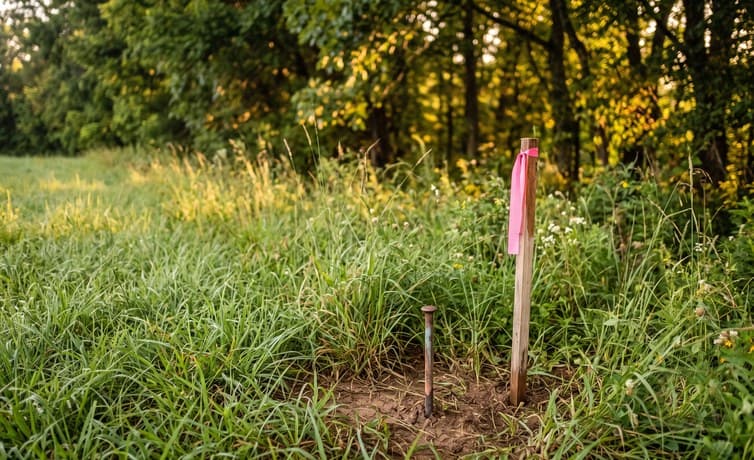
A licensed surveyor researches the deed, locates or resets the corner monuments, and produces a drawing showing exactly where your boundaries run, how much acreage you own, and any easements crossing the parcel. The corners get marked with iron pins and, usually, visible flagging or posts.
That paper matters. It's what you'll rely on when you build a fence, sell timber, put up a gate, or settle a friendly-but-firm conversation with a neighbor.
What Surveys Cost in 2026
Prices depend on parcel size, terrain, and how good the existing records are:
- Most rural parcels: roughly $500–$1,500 for a boundary survey.
- Larger acreage: often priced per acre — commonly $70–$140 per acre on tracts of 50–100 acres.
- Difficult tracts: heavily wooded, steep, or poorly documented land can run $4,000 or more.
Rural surveys often cost less than city work, but travel fees to remote parcels can add to the bill. Get two or three quotes — prices vary more than you'd expect.
When a Survey Is Worth It
You don't automatically need a fresh survey for every land purchase. It's most valuable when:
- You're planning to build — setback requirements make exact lines essential.
- The price per acre is high — a two-acre error on cheap grazing land stings; on expensive ground it's a serious loss.
- Boundaries are disputed or unclear — mismatched fences, vague deed language, or a neighbor who mows "their" strip of your field.
- You plan to fence or cut timber — cutting a neighbor's trees, even accidentally, can carry steep legal penalties.
- The deed description is old — metes-and-bounds descriptions referencing long-gone trees and stones deserve modern verification.
When You Can Reasonably Wait
If the parcel was recently surveyed, corners are pinned and findable, and you're buying for recreation rather than construction, many buyers rely on the existing survey and mapping tools for the near term — and commission a survey later when plans firm up.
What Else a Survey Can Reveal
A good survey shows more than lines on a map. Depending on the type you order, it can surface details that change how you use — or whether you buy — a property:
- Easements — utility lines, shared driveways, or a neighbor's deeded right to cross your land.
- Encroachments — a fence, shed, or driveway that sits on the wrong side of the line, yours or theirs.
- Acreage discrepancies — deeds sometimes promise more acres than the ground actually contains.
- Access confirmation — proof the parcel truly touches the road, not just appears to on a tax map.
Any one of these findings is worth far more than the survey costs. Easements and encroachments in particular are the kind of thing you want to know about before closing, while they're still the seller's problem to explain.
How to Check Boundaries Yourself First
Before paying anyone, do some homework:
- Pull the parcel map from the county assessor or GIS website — most counties offer free online viewers.
- Walk the property with a GPS mapping app that overlays parcel lines; they're approximate but useful.
- Look for existing corner pins, capped rebar, painted trees, or old fence corners.
- Read the deed and any prior survey on file at the courthouse.
These tools won't replace a surveyor, but they'll tell you whether the boundaries roughly match what's being sold — and flag anything worth investigating before closing. An hour of desk research and a good walk of the lines is the cheapest due diligence there is.
Buy with Confidence from Classic Country Land
The simplest way to avoid boundary surprises is to buy from a seller who knows their properties and shows them honestly. Classic Country Land has been helping people become landowners for more than 25 years, with mapped parcels, straightforward descriptions, and in-house owner financing on every property — no credit or background checks required.
Down payments start at just $999, plus a one-time $249 document fee at closing, with fixed monthly payments that fit real budgets. With properties across 20+ states, your future homesite, hunting tract, or weekend getaway is out there waiting.
Browse current listings at classiccountryland.com or call 972-649-6200. We'll help you know exactly what you're buying — down to the corner pins.
What you pay upfront: $999 down, plus a one-time $249 document fee at closing.
Financing disclosure: Basic-plan payments shown assume $999 down at 10.99% APR, amortized over terms up to 20 years — some contracts include a balloon payment, typically due after three years, when the remaining balance is refinanced or paid. Rates, discounts, and terms are subject to adjustment without notice.
Ask ten rural landowners where their property lines are and you'll get a mix of confident answers, educated guesses, and honest shrugs. Old fence lines wander off the true boundary. Corner pins disappear under decades of leaves. And "the line runs from that big oak to the creek" is how boundary disputes get started.
A land survey removes the guesswork. But surveys cost real money, and not every purchase needs one on day one. Here's how to decide what makes sense for the land you're looking at — and what it will cost you.
What a Boundary Survey Actually Gives You
A licensed surveyor researches the deed, locates or resets the corner monuments, and produces a drawing showing exactly where your boundaries run, how much acreage you own, and any easements crossing the parcel. The corners get marked with iron pins and, usually, visible flagging or posts.
That paper matters. It's what you'll rely on when you build a fence, sell timber, put up a gate, or settle a friendly-but-firm conversation with a neighbor.
What Surveys Cost in 2026
Prices depend on parcel size, terrain, and how good the existing records are:
- Most rural parcels: roughly $500–$1,500 for a boundary survey.
- Larger acreage: often priced per acre — commonly $70–$140 per acre on tracts of 50–100 acres.
- Difficult tracts: heavily wooded, steep, or poorly documented land can run $4,000 or more.
Rural surveys often cost less than city work, but travel fees to remote parcels can add to the bill. Get two or three quotes — prices vary more than you'd expect.
When a Survey Is Worth It
You don't automatically need a fresh survey for every land purchase. It's most valuable when:
- You're planning to build — setback requirements make exact lines essential.
- The price per acre is high — a two-acre error on cheap grazing land stings; on expensive ground it's a serious loss.
- Boundaries are disputed or unclear — mismatched fences, vague deed language, or a neighbor who mows "their" strip of your field.
- You plan to fence or cut timber — cutting a neighbor's trees, even accidentally, can carry steep legal penalties.
- The deed description is old — metes-and-bounds descriptions referencing long-gone trees and stones deserve modern verification.
When You Can Reasonably Wait
If the parcel was recently surveyed, corners are pinned and findable, and you're buying for recreation rather than construction, many buyers rely on the existing survey and mapping tools for the near term — and commission a survey later when plans firm up.
What Else a Survey Can Reveal
A good survey shows more than lines on a map. Depending on the type you order, it can surface details that change how you use — or whether you buy — a property:
- Easements — utility lines, shared driveways, or a neighbor's deeded right to cross your land.
- Encroachments — a fence, shed, or driveway that sits on the wrong side of the line, yours or theirs.
- Acreage discrepancies — deeds sometimes promise more acres than the ground actually contains.
- Access confirmation — proof the parcel truly touches the road, not just appears to on a tax map.
Any one of these findings is worth far more than the survey costs. Easements and encroachments in particular are the kind of thing you want to know about before closing, while they're still the seller's problem to explain.
How to Check Boundaries Yourself First
Before paying anyone, do some homework:
- Pull the parcel map from the county assessor or GIS website — most counties offer free online viewers.
- Walk the property with a GPS mapping app that overlays parcel lines; they're approximate but useful.
- Look for existing corner pins, capped rebar, painted trees, or old fence corners.
- Read the deed and any prior survey on file at the courthouse.
These tools won't replace a surveyor, but they'll tell you whether the boundaries roughly match what's being sold — and flag anything worth investigating before closing. An hour of desk research and a good walk of the lines is the cheapest due diligence there is.
Buy with Confidence from Legacy Land
The simplest way to avoid boundary surprises is to buy from a seller who knows their properties and shows them honestly. Legacy Land has been helping people become landowners for more than 25 years, with mapped parcels, straightforward descriptions, and in-house owner financing on every property — no credit or background checks required.
Down payments start at just $999, plus a one-time $249 document fee at closing, with fixed monthly payments that fit real budgets. With properties across 20+ states, your future homesite, hunting tract, or weekend getaway is out there waiting.
Browse current listings at classiccountryland.com or call 972-649-6200. We'll help you know exactly what you're buying — down to the corner pins.
What you pay upfront: $999 down, plus a one-time $249 document fee at closing.
Financing disclosure: Basic-plan payments shown assume $999 down at 10.99% APR, amortized over terms up to 20 years — some contracts include a balloon payment, typically due after three years, when the remaining balance is refinanced or paid. Rates, discounts, and terms are subject to adjustment without notice.