
How Much Does It Cost to Drill a Water Well on Rural Land?
Ask any rural landowner what question they researched hardest before building, and “what will a well cost me?” is usually near the top of the list. Water is the make-or-break utility for a homesite, homestead, or off-grid cabin — and unlike electricity, you can’t run it in from the road.
The honest answer is a range: most complete residential well systems in 2026 land between $5,500 and $9,000, with the full spread running roughly $3,000 to $15,000 depending on depth, geology, and equipment.
Here’s how those numbers break down, and how to estimate the cost for a parcel before you ever sign a contract.
How Well Drilling Is Priced
Drillers quote by the foot, and the per-foot number depends on what they’re drilling through.
Drilling Only
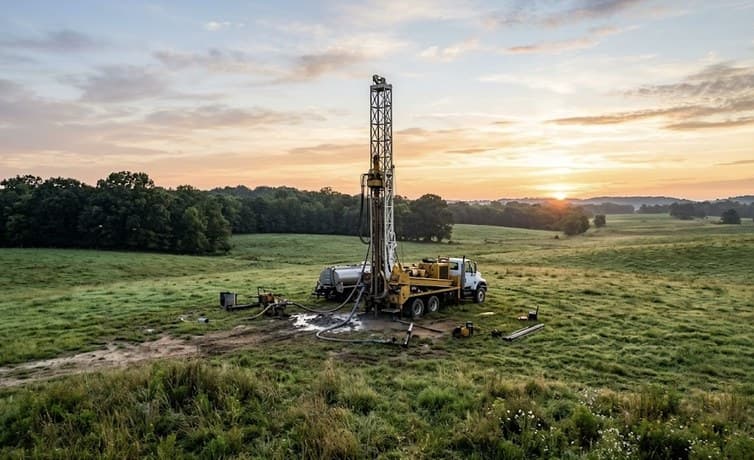
The hole itself typically runs $15 to $25 per foot in average conditions. That covers the rig, crew, and casing for the borehole — but not the equipment that actually delivers water to your tap.
Complete System
A finished well — drilling plus pump, pressure tank, wiring, and hookup — generally costs $25 to $65 per foot installed. A 200-foot well at $35 per foot all-in lands around $7,000, right in the middle of the national range.
What Geology Does to the Price
- Soft formations (sand, clay, loose gravel) — cheapest to drill, roughly $15–$35 per foot.
- Sedimentary rock (sandstone, limestone) — mid-range, about $30–$55 per foot.
- Hard crystalline rock (granite, basalt) — the expensive stuff, $45–$65+ per foot.
- Remote or difficult sites — steep, rocky, or hard-to-reach parcels can push budgets to $50–$75 per foot.
Depth Is the Biggest Variable
Two neighbors can pay wildly different prices for the same quality well simply because the water table sits deeper on one side of the hill. A 100-foot well and a 400-foot well might be a $10,000 difference.
Before you buy land where a well matters, do this simple homework:
- Ask the neighbors — nearby wells are the best predictor of your depth and water quality.
- Check state well logs — most states publish drilling records online, searchable by location.
- Call a local driller — they’ve likely drilled in that county and can quote a realistic range over the phone.
- Ask the seller — whether any well has been drilled, attempted, or permitted on the parcel.
Costs Beyond the Drilling
A realistic budget includes a few line items that first-timers often miss.
- Well permit — required in most states, usually a modest county or state fee.
- Pump and pressure tank — included in full-system quotes, but confirm it.
- Trenching to the homesite — running the water line from wellhead to cabin or house.
- Power for the pump — grid connection or a solar pump setup for off-grid builds.
- Water testing — an inexpensive step that tells you what filtration, if any, you need.
The Off-Grid Alternative
Plenty of recreational landowners skip the well entirely for years. Hauled water and cistern storage cover a camp or weekend cabin for a fraction of the cost, and rainwater collection works well in wetter states. A well is the long-term answer for a full-time home — but it doesn’t have to be a day-one expense, and your land is perfectly usable while you save for it.
Should Well Cost Change Which Land You Buy?
Sometimes, yes. A bargain parcel over 500 feet of granite can cost more to water than a slightly pricier parcel sitting on a shallow aquifer. When you compare two properties, compare them with the well estimate included — that’s the true cost of a buildable homesite.
But don’t let the well question scare you away from raw land altogether. Millions of rural households run happily on well water, the technology is mature, and local drillers make honest work of it every day. It’s a knowable, plannable cost — not a gamble. And unlike a monthly water bill, a well is a one-time investment that adds lasting value to the property: a parcel with a producing well is worth meaningfully more than the same parcel without one.
Buy Rural Land the Affordable Way with Classic Country Land
The easiest way to afford the well is to save money on the land. Classic Country Land has been helping people become landowners for more than 25 years with in-house owner financing on every property — no credit or background checks, ever.
Down payments start at just $999, plus a one-time $249 document fee at closing, and fixed monthly payments leave room in the budget for the improvements that matter — like the well, the driveway, and the cabin. With properties across 14 states, you can find land where the water sits close to the surface and the neighbors already know the driller’s number.
Browse current listings at classiccountryland.com or call 972-649-6200. Your land is out there — and the water underneath it, too.
Ask any rural landowner what question they researched hardest before building, and “what will a well cost me?” is usually near the top of the list. Water is the make-or-break utility for a homesite, homestead, or off-grid cabin — and unlike electricity, you can’t run it in from the road.
The honest answer is a range: most complete residential well systems in 2026 land between $5,500 and $9,000, with the full spread running roughly $3,000 to $15,000 depending on depth, geology, and equipment.
Here’s how those numbers break down, and how to estimate the cost for a parcel before you ever sign a contract.
How Well Drilling Is Priced
Drillers quote by the foot, and the per-foot number depends on what they’re drilling through.
Drilling Only
The hole itself typically runs $15 to $25 per foot in average conditions. That covers the rig, crew, and casing for the borehole — but not the equipment that actually delivers water to your tap.
Complete System
A finished well — drilling plus pump, pressure tank, wiring, and hookup — generally costs $25 to $65 per foot installed. A 200-foot well at $35 per foot all-in lands around $7,000, right in the middle of the national range.
What Geology Does to the Price
- Soft formations (sand, clay, loose gravel) — cheapest to drill, roughly $15–$35 per foot.
- Sedimentary rock (sandstone, limestone) — mid-range, about $30–$55 per foot.
- Hard crystalline rock (granite, basalt) — the expensive stuff, $45–$65+ per foot.
- Remote or difficult sites — steep, rocky, or hard-to-reach parcels can push budgets to $50–$75 per foot.
Depth Is the Biggest Variable
Two neighbors can pay wildly different prices for the same quality well simply because the water table sits deeper on one side of the hill. A 100-foot well and a 400-foot well might be a $10,000 difference.
Before you buy land where a well matters, do this simple homework:
- Ask the neighbors — nearby wells are the best predictor of your depth and water quality.
- Check state well logs — most states publish drilling records online, searchable by location.
- Call a local driller — they’ve likely drilled in that county and can quote a realistic range over the phone.
- Ask the seller — whether any well has been drilled, attempted, or permitted on the parcel.
Costs Beyond the Drilling
A realistic budget includes a few line items that first-timers often miss.
- Well permit — required in most states, usually a modest county or state fee.
- Pump and pressure tank — included in full-system quotes, but confirm it.
- Trenching to the homesite — running the water line from wellhead to cabin or house.
- Power for the pump — grid connection or a solar pump setup for off-grid builds.
- Water testing — an inexpensive step that tells you what filtration, if any, you need.
The Off-Grid Alternative
Plenty of recreational landowners skip the well entirely for years. Hauled water and cistern storage cover a camp or weekend cabin for a fraction of the cost, and rainwater collection works well in wetter states. A well is the long-term answer for a full-time home — but it doesn’t have to be a day-one expense, and your land is perfectly usable while you save for it.
Should Well Cost Change Which Land You Buy?
Sometimes, yes. A bargain parcel over 500 feet of granite can cost more to water than a slightly pricier parcel sitting on a shallow aquifer. When you compare two properties, compare them with the well estimate included — that’s the true cost of a buildable homesite.
But don’t let the well question scare you away from raw land altogether. Millions of rural households run happily on well water, the technology is mature, and local drillers make honest work of it every day. It’s a knowable, plannable cost — not a gamble. And unlike a monthly water bill, a well is a one-time investment that adds lasting value to the property: a parcel with a producing well is worth meaningfully more than the same parcel without one.
Buy Rural Land the Affordable Way with Legacy Land
The easiest way to afford the well is to save money on the land. Legacy Land has been helping people become landowners for more than 25 years with in-house owner financing on every property — no credit or background checks, ever.
Down payments start at just $999, plus a one-time $249 document fee at closing, and fixed monthly payments leave room in the budget for the improvements that matter — like the well, the driveway, and the cabin. With properties across 14 states, you can find land where the water sits close to the surface and the neighbors already know the driller’s number.
Browse current listings at classiccountryland.com or call 972-649-6200. Your land is out there — and the water underneath it, too.