
How to Get an Address, Mail, and Internet on Rural Land
Power, water, and septic get all the attention when people talk about developing raw land. Then you go to order a delivery, register a vehicle, or set up service — and discover the parcel doesn't have an address at all.
It's a small problem with an outsized effect. Almost every modern service assumes an address exists. Fixing it isn't hard, but the order of operations matters.
Here's how address, mail, and internet actually get set up on rural property.
Step One: Get a 911 Address Assigned
Rural parcels are identified by a parcel number and a legal description, not a street address. The street address gets created by your county's 911 addressing authority.
Find the Right Office
Depending on the county, addressing sits inside emergency communications, emergency management, the GIS or mapping department, the appraisal district, or a regional council of governments. Searching "[your county] 911 addressing" almost always finds it.
Know the Usual Requirement
Most counties will not assign an address to a parcel that has nothing on it. An address typically gets issued when there's a structure being built or placed — often bundled with the building permit — because responders need a real destination.
Establish a Fixed Access Point
The near-universal prerequisite is one permanent driveway or entrance. Addressing staff assign the number based on measured distance along the road to your access point, so the driveway has to exist and stay put before the number is final.
What to Bring
- Parcel ID or tax ID number
- A map or GPS coordinates of the driveway location
- Proposed structure or homesite location
- The building permit application, if one is required
Once assigned, the county posts the address to the 911 database and usually requires you to display the number at the road on a post or reflective marker.
Step Two: Set Up Mail Delivery
An address in the county database doesn't automatically mean the postal carrier stops at your driveway. That's a separate conversation with the local post office.
- Talk to the postmaster of the town that serves your area — not a national number. Rural route decisions are local.
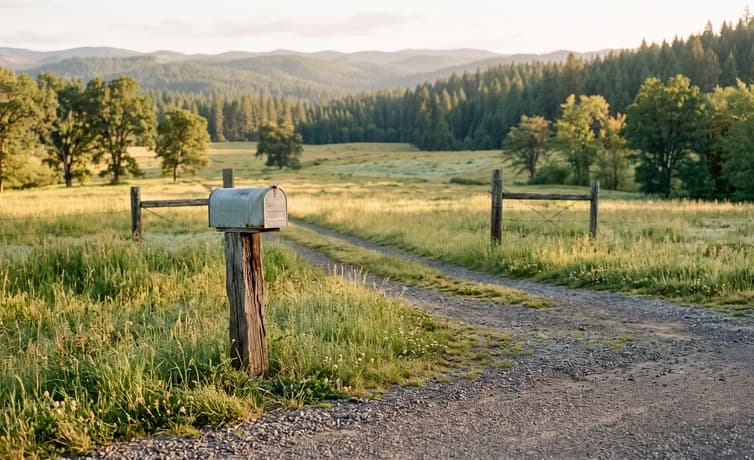
- Ask whether your road is on a delivery route. If it is, you'll be told exactly where to place a box and at what height and setback.
- If it isn't, a PO box is the standard fallback, and many rural landowners keep one permanently.
- Watch for cluster box units on newer rural roads, where mail is delivered to a shared bank of boxes rather than individual driveways.
- Expect carriers to need the number posted at the road before regular delivery starts.
One quirk worth knowing: your mailing address and your 911 address are occasionally different, and some counties and carriers handle that better than others. Confirm both when you set up service.
Step Three: Get Internet Service
This has changed more in the last few years than anything else on rural land.
Satellite
Low-earth-orbit satellite is now the default answer for genuinely remote property. Starlink residential plans currently run about $55 a month for the 100 Mbps tier, $80 for 200 Mbps, and $130 for the top residential tier, with the standard kit at $349 up front or rentable monthly. No contract, and it works anywhere with a clear view of the sky.
Fixed Wireless
Local wireless internet providers beam service from a tower to a small antenna on your roof or a pole. Where it's available it's often cheaper than satellite, but it needs line of sight to the tower, so terrain and timber decide whether it works.
Cellular Home Internet
If you get a solid signal on the property, a carrier's home internet plan can be a good value. Test the actual signal standing on the land — coverage maps are optimistic.
Wired Broadband
Federal rural broadband funding keeps pushing fiber further out than most people expect. Before assuming there's nothing, check the FCC broadband map for your coordinates and call the local co-op or telephone company.
A Practical Sequence
- Test cell signal while you're walking the property.
- Check the FCC map and the local co-op for wired service.
- Ask neighbors what they actually use — the fastest research there is.
- Treat satellite as the guaranteed fallback.
Start with the Right Piece of Land — Classic Country Land
Every one of these steps is easier when you start with a parcel that has good road access and a clear place to put a driveway. Classic Country Land has been selling rural property for more than 25 years, and we're straightforward about what a parcel has and doesn't have.
Our in-house owner financing means no credit check and no background check. Down payments start at just $999, with a one-time $249 document fee at closing and a fixed monthly payment after that. We sell land in 20+ states, and our properties carry only light covenants designed to keep neighboring parcels from being trashed — you keep the freedom to build, camp, or go off grid.
Browse listings at classiccountryland.com or call 972-649-6200.
What you pay upfront: $999 down, plus a one-time $249 document fee at closing.
Financing disclosure: Basic-plan payments shown assume $999 down at 10.99% APR, amortized over terms up to 20 years — some contracts include a balloon payment, typically due after three years, when the remaining balance is refinanced or paid. Rates, discounts, and terms are subject to adjustment without notice.
Power, water, and septic get all the attention when people talk about developing raw land. Then you go to order a delivery, register a vehicle, or set up service — and discover the parcel doesn't have an address at all.
It's a small problem with an outsized effect. Almost every modern service assumes an address exists. Fixing it isn't hard, but the order of operations matters.
Here's how address, mail, and internet actually get set up on rural property.
Step One: Get a 911 Address Assigned
Rural parcels are identified by a parcel number and a legal description, not a street address. The street address gets created by your county's 911 addressing authority.
Find the Right Office
Depending on the county, addressing sits inside emergency communications, emergency management, the GIS or mapping department, the appraisal district, or a regional council of governments. Searching "[your county] 911 addressing" almost always finds it.
Know the Usual Requirement
Most counties will not assign an address to a parcel that has nothing on it. An address typically gets issued when there's a structure being built or placed — often bundled with the building permit — because responders need a real destination.
Establish a Fixed Access Point
The near-universal prerequisite is one permanent driveway or entrance. Addressing staff assign the number based on measured distance along the road to your access point, so the driveway has to exist and stay put before the number is final.
What to Bring
- Parcel ID or tax ID number
- A map or GPS coordinates of the driveway location
- Proposed structure or homesite location
- The building permit application, if one is required
Once assigned, the county posts the address to the 911 database and usually requires you to display the number at the road on a post or reflective marker.
Step Two: Set Up Mail Delivery
An address in the county database doesn't automatically mean the postal carrier stops at your driveway. That's a separate conversation with the local post office.
- Talk to the postmaster of the town that serves your area — not a national number. Rural route decisions are local.
- Ask whether your road is on a delivery route. If it is, you'll be told exactly where to place a box and at what height and setback.
- If it isn't, a PO box is the standard fallback, and many rural landowners keep one permanently.
- Watch for cluster box units on newer rural roads, where mail is delivered to a shared bank of boxes rather than individual driveways.
- Expect carriers to need the number posted at the road before regular delivery starts.
One quirk worth knowing: your mailing address and your 911 address are occasionally different, and some counties and carriers handle that better than others. Confirm both when you set up service.
Step Three: Get Internet Service
This has changed more in the last few years than anything else on rural land.
Satellite
Low-earth-orbit satellite is now the default answer for genuinely remote property. Starlink residential plans currently run about $55 a month for the 100 Mbps tier, $80 for 200 Mbps, and $130 for the top residential tier, with the standard kit at $349 up front or rentable monthly. No contract, and it works anywhere with a clear view of the sky.
Fixed Wireless
Local wireless internet providers beam service from a tower to a small antenna on your roof or a pole. Where it's available it's often cheaper than satellite, but it needs line of sight to the tower, so terrain and timber decide whether it works.
Cellular Home Internet
If you get a solid signal on the property, a carrier's home internet plan can be a good value. Test the actual signal standing on the land — coverage maps are optimistic.
Wired Broadband
Federal rural broadband funding keeps pushing fiber further out than most people expect. Before assuming there's nothing, check the FCC broadband map for your coordinates and call the local co-op or telephone company.
A Practical Sequence
- Test cell signal while you're walking the property.
- Check the FCC map and the local co-op for wired service.
- Ask neighbors what they actually use — the fastest research there is.
- Treat satellite as the guaranteed fallback.
Start with the Right Piece of Land — Legacy Land
Every one of these steps is easier when you start with a parcel that has good road access and a clear place to put a driveway. Legacy Land has been selling rural property for more than 25 years, and we're straightforward about what a parcel has and doesn't have.
Our in-house owner financing means no credit check and no background check. Down payments start at just $999, with a one-time $249 document fee at closing and a fixed monthly payment after that. We sell land in 20+ states, and our properties carry only light covenants designed to keep neighboring parcels from being trashed — you keep the freedom to build, camp, or go off grid.
Browse listings at classiccountryland.com or call 972-649-6200.
What you pay upfront: $999 down, plus a one-time $249 document fee at closing.
Financing disclosure: Basic-plan payments shown assume $999 down at 10.99% APR, amortized over terms up to 20 years — some contracts include a balloon payment, typically due after three years, when the remaining balance is refinanced or paid. Rates, discounts, and terms are subject to adjustment without notice.